Flying with Camera Gear
The first time I took my team to a remote location, getting the equipment there safely was one of my biggest worries. I’ve watched suitcases tumble out of trucks zipping around the tarmac, I’ve seen ground crew chucking bags through the air, and I’ve heard plenty of stories of lost and damaged luggage.
So I called up a few seasoned colleagues for advice, and did a bit of research, and things worked out … pretty ok! Here’s my current approach, and some thoughts behind it, for my own notes and perhaps the interest other production teams.
It seems like luggage rules change every time I fly, so I’m intentionally avoiding some specifics. Before any trip, I’m always doing some quick research on the specific airline, and carrying a printout of their policies isn’t a bad idea either.
Can I Just Rent the Gear?
Right off the bat, I’d prefer to have equipment arrive on site and not deal with the extra hassle at the airport.
Renting has some risks, but mail-order rentals and checked baggage both risk equipment arriving late, arriving damaged, or not arriving at all. Airlines and shipping services can both be extremely rough on equipment; this is pretty much a tie.
The biggest difference is who’s doing the packing: rental companies or me. Spoiler: they’re better at it.
The R&D rental companies put into proper packing is impressive. I’m improving, especially the more I ship used gear on eBay, but these people are shipping every day.
Just like any equipment rental, the limitations are availability, schedule, and location.
Availability: the gear I need for the specific job might not be in their inventory, or is unavailable the week I need it.
Schedule: We need enough time after arrival for unpacking, assembling, and testing the day before the shoot. Batteries might need charging, too. Later, there’s the return process. I need to make sure I can get to a FedEx/UPS during their business hours, after the shoot. Sometimes this means making a pitstop on the way to the airport for departure.
Location: I haven’t tried to get things delivered to international and extremely remote locations, but I bet that’s tricky. For hotels, I’ll call ahead and discuss having a package shipped there. The biggest issue is having to sign for the package, especially if it arrives ahead of us. So far, hotels have been accommodating and signed for packages ahead of my arrival.
Carry-on
Carry-on is ideal for delicate gear like cameras and lenses, if they’re small enough to fit a regulation carry-on bag. I want control of how they’re handled, and I want to arrive with a functional kit in hand no matter what else has gone awry. After some disassembly, I can fit both my Sony FS5 kits and a laptop in a sturdy Lowepro backpack.
When I’m traveling with my crew, the additional carry-ons are a big help (if the crew doesn’t mind!)
I figure clothing can always go in checked luggage, it’s not fragile and it’s easier to replace.
However, there is a possibility of carry-ons being gate-checked at the last minute!
The gate-check is a serious problem if I’ve packed poorly, assuming my gear will only be handled by me. I like to speak with the gate attendant early and explain that I’m carrying fragile luggage, and find out if there are any steps I need to take to avoid gate-checking them. (But packing securely is still the best practice.)
Checked Luggage
Less fragile equipment, like a case full of tripods, cables, and gaff tape, can go in a hard-shell case with a bit of padding, and get checked. I take good care of my tripods, but they can get banged around a bit. Disassembled, I was able to pack five tripods in a Pelican Air 1615 (Manfrotto MT190X3 with 502AH video heads, if you’re curious!)
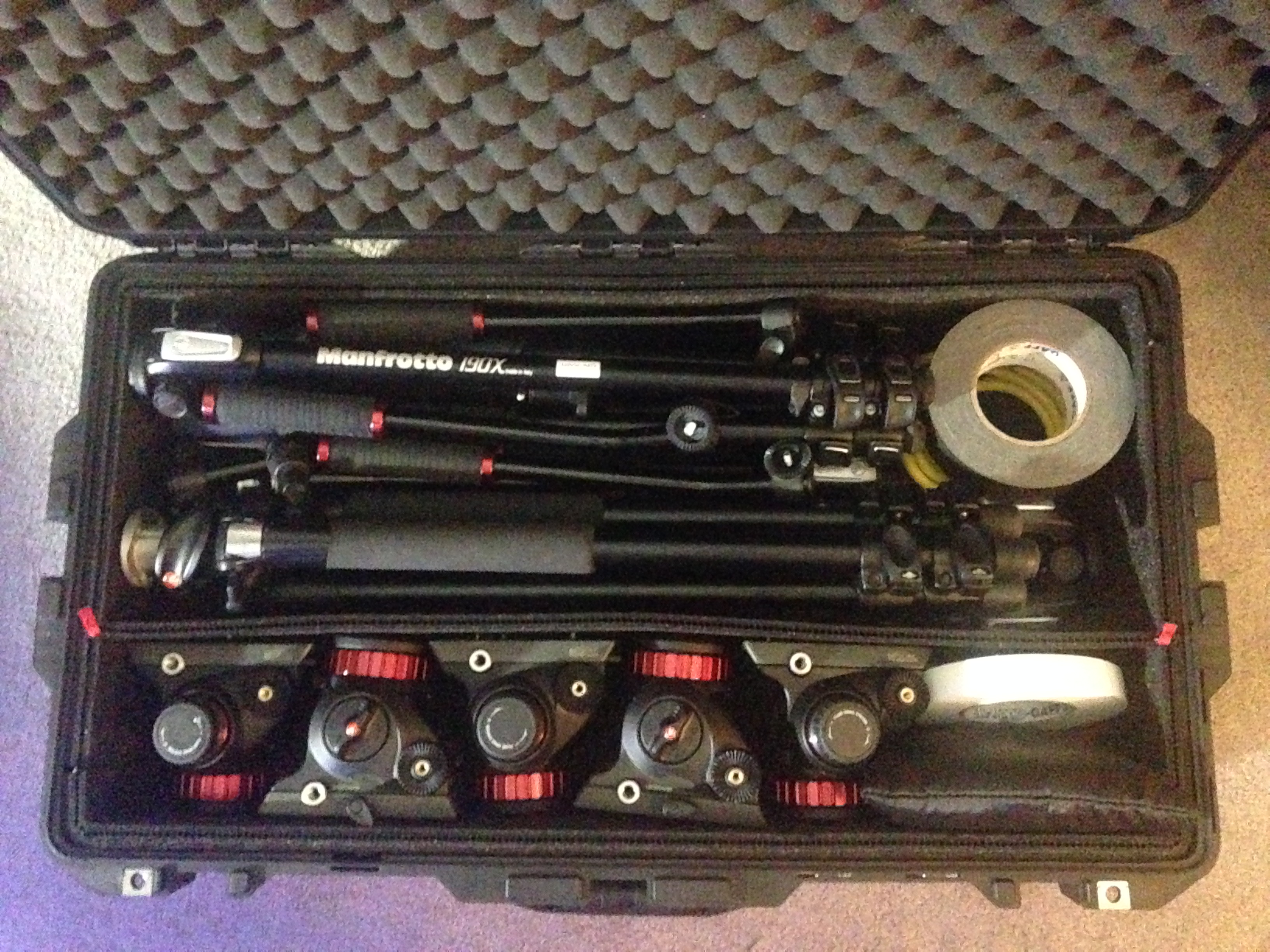
Media Rate
Production equipment quickly exceeds weight limits and racks up baggage fees. Some airlines have a “Media Rate," which gives media crew a flat fee per checked bag, to save some cost. At my local airport though, the staff had no idea about this option and it took some time to look into it. When we figured it out, they applied the flat rate to my Pelican case, and a small 10lb audio kit I was carrying. The smaller/lighter bag would have been cheaper without the special rate! So I learned to do more research up front and compare options.
Luggage Handling
Cases: I have several rigid cases from Pelican and similar brands. They are rugged enough, relatively easy to maneuver, and come in standard luggage sizes. These get everyday use from my crew, and fly really well too.
There’s a reason much of the entertainment industry uses “flight cases” - those big black rolling boxes you see everywhere. I’ve never tried flying with these though, so I can’t speak to that experience. The traditional style is made from thick plywood, with a tough black laminate coating, and metal reinforced edges and corners. Sounds awesome if they’ll let you fly with it.
Padding and packing: Regardless of the outer shell, your equipment isn’t secure if it’s bouncing around inside. If the contents are fragile like camera bodies and lenses, you want these surrounded on all sides with thick foam padding and no wiggle room.
Murphy’s Law in action: Airlines will open, unpack, and inspect checked bags. I’ve heard of cases being re-packed incorrectly, and taped shut with the lid ajar. I don’t know how to avoid this, but I feel like cases with special slots for each item are more likely to be repacked correctly.
Misc Tips for Traveling with Equipment
In addition to the above, here are some other best practices in my opinion:
- Inconspicuous is best (no point packing well if the kit gets stolen)
- Be Nice
- Label all cases, and their contents, with a name and phone number
- Doesn’t hurt to call ahead and discuss with the airline. They can put a note on the booking.
- Adjacent industry: Fliers travel with snowboards, musical instruments, bicycles, etc. Consider looking there for advice if you can’t find what you need. For example, maybe light stands and tripods would fit in snowboard bags, padded with clothing.
Thanks for reading, safe travels!
Share this on: Facebook | LinkedIn | Reddit
Further Reading
Previously: In His Element
Back to All Blog Posts